When Segmentation Fails Silently: How ARP Behavior Exposes the Gaps in Your Subnet Isolation Strategy
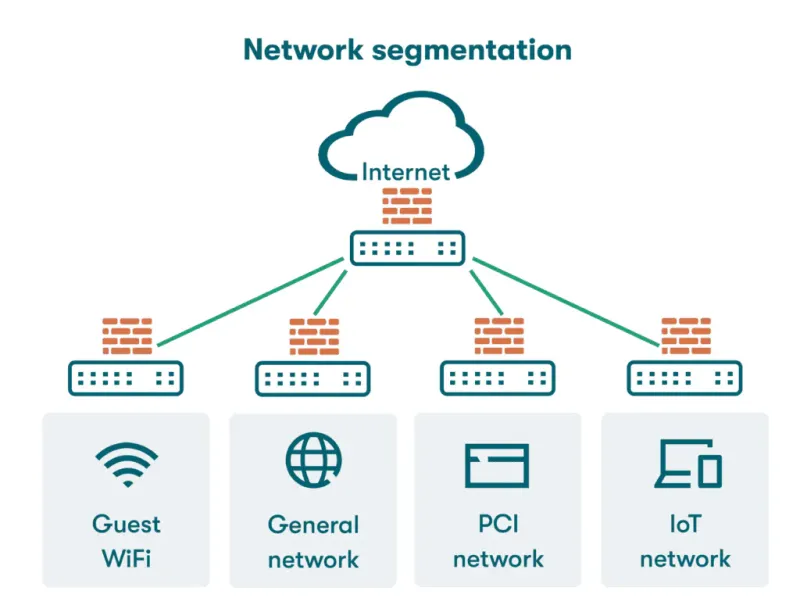
Photo: network segmentation diagram server room enterprise IT infrastructure, via envescent.com
Network segmentation is one of the most widely cited controls in enterprise security architecture. Compliance frameworks reference it. Auditors check for it. Security teams spend months designing it. And yet, in a surprising number of organizations, the segmentation they believe is in place is quietly undermined by a protocol that operates well below the firewall's line of sight: the Address Resolution Protocol.
ARP does not respect the logical boundaries that security architects draw on network diagrams. It operates at Layer 2, where it resolves IP addresses to MAC addresses so that devices can communicate on a local network segment. The problem arises when the physical or virtual infrastructure does not enforce the same boundaries that the IP addressing scheme implies. When that alignment breaks down, ARP traffic crosses subnet lines that were never intended to be permeable — and the organization rarely knows it is happening.
The Architecture Assumption That Creates the Problem
Most network segmentation strategies are designed with Layer 3 in mind. Subnets are carved out, routing policies are defined, and firewall rules are written to control traffic between zones. What this approach often overlooks is that Layer 2 infrastructure — switches, VLANs, and trunk links — must be configured with equal precision if the segmentation is to hold.
Consider a common scenario in mid-sized enterprise environments. An organization segments its network into three zones: a corporate user segment, a server segment, and a guest wireless segment. Firewall rules block direct routing between these zones. On paper, the isolation looks solid. In practice, however, the underlying switch configuration has trunk ports carrying traffic from multiple VLANs without strict VLAN pruning. A misconfigured access port, an incorrect native VLAN assignment, or a missing VLAN boundary on a virtual switch in a hypervisor environment can allow ARP broadcasts to reach devices in adjacent segments.
The result is that devices in what should be isolated segments begin receiving ARP broadcasts from hosts they were never meant to communicate with. In some cases, they respond. In others, they simply populate their ARP caches with entries that should not exist. Either way, the isolation has failed — and the firewall, operating at Layer 3, has no visibility into what just happened.
Why Compliance Audits Routinely Miss This Exposure
Compliance frameworks such as PCI DSS, HIPAA Security Rule technical safeguards, and NIST SP 800-53 all require some form of network segmentation or access control between sensitive environments. However, the audit processes used to verify compliance typically focus on firewall rule reviews, routing table analysis, and IP-level connectivity testing. They do not systematically examine Layer 2 ARP behavior across segment boundaries.
This creates a meaningful gap. An organization can pass a segmentation audit while simultaneously having ARP broadcasts traversing boundaries that the audit was designed to verify as closed. The auditor confirms that no routed path exists between the cardholder data environment and the corporate network. What the audit does not confirm is whether ARP traffic from the corporate segment is reaching Layer 2 infrastructure shared with the cardholder environment.
For IT professionals preparing for or maintaining certifications in network security, this distinction is critical. Understanding where Layer 2 controls must supplement Layer 3 policy is not an advanced edge case — it is a foundational competency that separates professionals who understand how networks actually behave from those who understand only how they are documented.
Real-World Failure Patterns Security Teams Encounter
Several recurring configurations consistently produce ARP-based segmentation failures in enterprise environments.
Misconfigured hypervisor virtual switches are among the most common culprits in modern data centers. When virtual machines assigned to different network zones share a physical host, the virtual switch configuration must enforce VLAN separation with the same rigor as a physical switch. Misconfigured port groups, missing VLAN tags, or incorrect promiscuous mode settings can allow ARP traffic to flow between VMs that should have no Layer 2 adjacency whatsoever.
Trunk link misconfiguration on physical switches produces similar outcomes in traditional infrastructure. When a trunk port carries VLANs that should remain isolated from one another on the same physical segment, ARP broadcasts originating in one VLAN can reach devices in another if VLAN pruning is not enforced or if the native VLAN is incorrectly assigned.
Flat network legacy segments that have been partially segmented over time represent another persistent risk. Organizations that have grown their networks incrementally often have legacy subnets that share Layer 2 broadcast domains with newer, ostensibly segmented zones. ARP traffic in these environments can traverse boundaries that network diagrams show as separated, simply because the underlying infrastructure was never fully restructured to match the intended architecture.
A Diagnostic Framework for Identifying ARP Boundary Failures
Identifying these gaps requires a methodical approach that examines Layer 2 behavior directly rather than inferring it from IP-level connectivity tests.
Step one: Map your broadcast domains independently of your IP addressing scheme. Do not assume that subnet boundaries align with VLAN or broadcast domain boundaries. Use switch configuration audits and VLAN membership reports to verify that every interface carrying traffic from a given subnet belongs to the correct VLAN and that no trunk links are propagating that VLAN to segments where it should not appear.
Step two: Conduct ARP broadcast monitoring across segment boundaries. Deploy packet capture at strategic points in your network — specifically at Layer 2 boundaries between segments — and examine whether ARP broadcasts originating in one segment are visible in adjacent segments. Tools such as Wireshark, tcpdump, or purpose-built network analysis platforms can capture this traffic. The presence of ARP broadcasts from a foreign subnet in a monitored segment is a definitive indicator of boundary failure.
Step three: Audit ARP cache entries on hosts in sensitive segments. If a host in a supposedly isolated segment has ARP cache entries corresponding to IP addresses from a different subnet, that is direct evidence that Layer 2 adjacency exists where it should not. Regular ARP cache audits on critical hosts — particularly those in compliance-sensitive environments — can surface these anomalies before they are exploited.
Step four: Review Dynamic ARP Inspection policies for completeness. DAI is a widely deployed control, but its effectiveness depends entirely on the accuracy of DHCP snooping binding tables and the completeness of its configuration across all relevant VLANs. Gaps in DAI coverage — particularly on trunk ports or in VLANs that were added to the network after the initial DAI deployment — can leave boundary failures undetected and unmitigated.
Remediation Priorities and Architectural Hardening
Once ARP boundary failures are identified, remediation must address both the immediate misconfiguration and the architectural conditions that allowed it to persist.
At the configuration level, VLAN pruning should be enforced on all trunk links so that only explicitly permitted VLANs traverse each trunk. Native VLAN assignments should be standardized and should never correspond to a VLAN carrying production traffic. Virtual switch configurations in hypervisor environments should be reviewed against the same standards applied to physical infrastructure, with VLAN tagging enforced at the port group level.
At the architectural level, organizations should evaluate whether their segmentation strategy relies too heavily on Layer 3 controls without sufficient Layer 2 enforcement. In environments where sensitive workloads share physical infrastructure with less-sensitive systems, additional isolation mechanisms — including private VLANs, micro-segmentation at the hypervisor layer, or dedicated physical infrastructure for the highest-sensitivity zones — may be warranted.
The Professional Competency That This Requires
For IT security professionals, the ability to reason across both Layer 2 and Layer 3 simultaneously is not optional in environments where segmentation is a compliance requirement. ARP behavior is the mechanism through which Layer 2 reality either supports or undermines Layer 3 policy. Professionals who can identify where these layers diverge — and who can translate that divergence into actionable remediation guidance — bring a level of diagnostic precision that organizations genuinely need.
At ARP Certificate, our curriculum is designed to build exactly this kind of protocol-level fluency. Understanding ARP is not merely an academic exercise. It is the foundation upon which credible network security practice is built — and the diagnostic lens through which segmentation failures, compliance gaps, and architectural vulnerabilities become visible before they become incidents.